



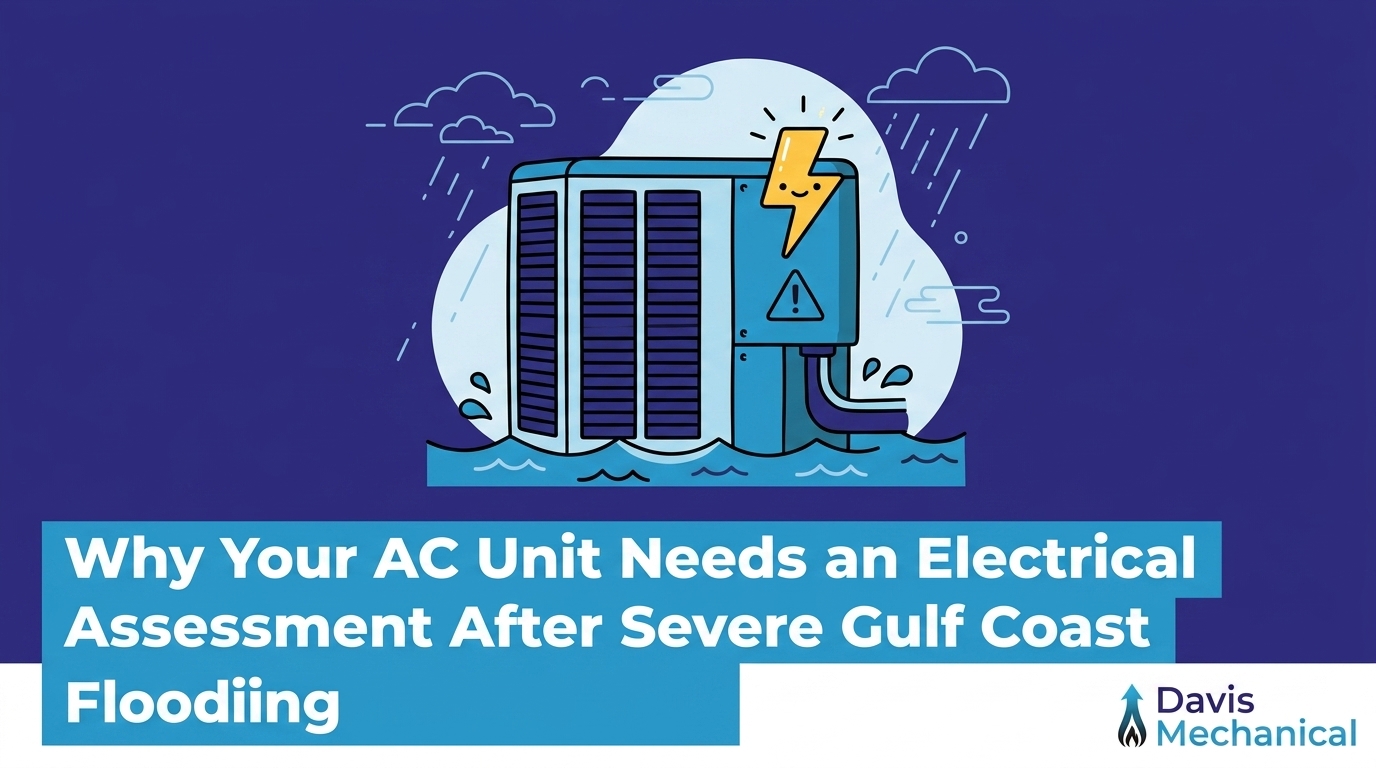
The Hidden Danger in Your Yard After Gulf Coast Floodwaters Recede
August and the late summer Gulf Coast hurricane season bring some of the most intense weather in the country, and understanding why your AC unit needs an electrical assessment after severe Gulf Coast flooding is critical for your safety. As the skies finally clear and the yard floodwaters begin to recede, the immediate instinct is to seek relief from the sweltering heat. The outdoor condenser looks completely dry in the sun, and the thermostat is blank, just waiting to be turned back on. However, a hidden danger lurks just behind the metal panels of your cooling equipment.
Homeowners often assume their air conditioning system is safe to operate simply because the exterior casing is no longer submerged. The concrete problem is that floodwaters leave behind invisible, highly conductive silt and hidden electrical corrosion deep inside the unit’s sealed compartments. You are immediately faced with a critical decision point: flipping the breaker to get immediate cooling relief, or waiting for a licensed professional to perform a thorough electrical evaluation. Choosing patience over immediate comfort prevents catastrophic system failure, protects your property from electrical fires, and ensures your family’s safety. If you need immediate assistance navigating post-storm recovery, explore our comprehensive HVAC services to ensure your system is restored safely and effectively.
Why a Dry Exterior Doesn’t Mean Your AC is Safe to Run
Modern outdoor air conditioning condensers are engineered to withstand extreme weather, but they are designed for a very specific type of moisture exposure. The engineering focuses heavily on top-down weather resistance, meaning standard rain, heavy downpours, and even hail are deflected away from sensitive internal components. However, these systems are absolutely not designed for submersion.
When standing water rises from the ground up, it bypasses the exterior louvers and penetrates the base pan, soaking the internal outdoor condenser electrical panels and contactors. Floodwater behaves very differently than falling rain. It is pressurized by its own weight, forcing its way into tiny crevices, wire casings, and sealed mechanical housings.
The illusion of a dry exterior: The metal cabinet of your AC unit heats up quickly in the direct sun, evaporating surface moisture within hours. This creates a dangerous false sense of security. Inside the shadowed, enclosed spaces of the electrical panel, moisture takes significantly longer to evaporate. Water can remain trapped inside the contactor housing, capacitor terminals, and compressor wiring harnesses for days or even weeks after the yard appears completely dry.
Turning on the system based purely on a visual exterior check is a major safety hazard. To understand the difference between standard weather and standing water, consider how moisture interacts with your equipment:
| Weather Event | Water Direction | Internal Drainage | Electrical Risk Level |
|---|---|---|---|
| Heavy Rainstorm | Top-down | Rapid draining through base pan | Low (system is designed for this) |
| Wind-Driven Rain | Lateral / Angled | Moderate draining, some splashback | Low to Moderate |
| Yard Flooding / Submersion | Bottom-up | Water trapped inside components | Extreme (high risk of dead shorts) |
How Invisible Silt Causes Catastrophic Electrical Shorts
The water itself is only the first phase of the danger. The true hazard lies in what the floodwaters leave behind. As standing water moves through neighborhoods, it picks up microscopic, highly conductive silt, mud, and organic debris. When this dirty water infiltrates your outdoor condenser electrical panels and contactors, it coats every wire, terminal, and switch.
As the trapped water finally evaporates, this microscopic silt does not disappear. Instead, it bakes onto the sensitive components, forming a hard, highly conductive crust. This is where the mechanical failure originates. The silt physically bridges the microscopic gaps between electrical contacts that are supposed to remain separated. When you flip the breaker, high-voltage electricity travels across this unintended path of baked-on silt, creating a dead short that can instantly destroy the compressor, melt the wiring harness, or start an electrical fire.
This process also explains the delayed-failure phenomenon. Sometimes, a homeowner turns the unit on and it runs fine for a few days. The silt is present, but the vibration and heat of the running unit slowly shift the debris until it finally bridges a connection. Suddenly, the system suffers a total blowout weeks after the storm has passed. If you are wondering why your AC is not cooling long after a major weather event, hidden silt corrosion is often the culprit.
The Vulnerability of the Contactor
To understand why this happens, you have to look at the contactor. The contactor is essentially a heavy-duty, high-voltage switch located inside your outdoor unit. When your indoor thermostat calls for cooling, it sends a low-voltage signal to the contactor. The contactor then magnetically pulls a heavy metal plate downward, connecting two high-voltage lines that send power to your compressor and fan motor.
Because the contactor relies on physical metal points touching and separating, it is incredibly susceptible to silt buildup. If conductive mud dries on those metal points, the switch cannot open or close properly. The electricity arcs across the dirt, generating extreme heat, welding the contacts together, and causing a catastrophic short circuit the moment the system tries to cycle on.

Why Salt and Agricultural Runoff Accelerate Corrosion
Not all floodwater is created equal, and our regional climate plays a massive role in how quickly HVAC equipment degrades after a storm. Clean rainwater is relatively pure, but the water that inundates Alvin, TX flood zones during a major weather event is a highly toxic, corrosive mixture.
Because of our coastal topography, storm surges push brackish, salt-tinged water far inland. Simultaneously, heavy torrential rains wash over inland farms and fields, collecting agricultural runoff. When these two forces meet in your backyard, they create a highly aggressive floodwater unique to the region.
- Brackish Salt Water: Salt is a notorious conductor of electricity and an aggressive oxidizer. When salt water dries on copper wiring and aluminum fins, it rapidly accelerates galvanic corrosion.
- Agricultural Runoff: Fertilizers contain high levels of nitrogen and phosphorus. When dissolved in floodwater, these chemicals act as an acid on your system’s delicate metal alloys.
- Petrochemical Residue: Runoff from flooded roads carries motor oil, antifreeze, and gasoline into your yard, leaving a sticky film on HVAC components that traps heat and degrades wire insulation.
This toxic mix degrades wiring insulation and metal contacts much faster than normal wear and tear. A unit submerged in clean tap water might survive with a thorough professional cleaning, but a unit submerged in coastal agricultural floodwater is subjected to a chemical attack that destroys copper lines and electrical boards from the outside in.
Storm Recovery Lessons from Hurricane Harvey
Navigating the aftermath of a massive storm requires specific, localized expertise. In our experience restoring local HVAC systems after Hurricane Harvey, we witnessed firsthand the widespread HVAC submersion that devastated neighborhoods. The most critical lesson learned during that August / late summer Gulf Coast hurricane season was the reality of delayed electrical failures. Homeowners who bypassed professional inspections and turned their systems on immediately often saw their units run for a week before suffering catastrophic compressor burnouts due to hidden silt.
Our direct experience dictates a highly cautious, professional approach to restarting systems. Restoring comfort rapidly is essential in extreme heat, but it must be done safely to prevent turning a repairable situation into a total system replacement.
While major hurricanes dominate the headlines, severe spring storms also cause significant property disruption. During one spring recovery effort, a local customer reached out because their system required comprehensive AC repair and duct work following a severe weather event. Our technicians arrived promptly, fixed the AC components, completed the necessary duct work, and thoroughly cleaned the workspace, ensuring the job was finished on time with no mess left behind. This level of comprehensive, guaranteed service is exactly what homeowners need to restore safe, reliable cooling after extreme weather.
Secondary Storm Damage Risks Beyond the Compressor
While the outdoor condenser takes the brunt of the visible flooding, heavy storms often cause concurrent damage to other parts of your home’s thermal envelope. The same weather event that flooded your yard likely brought high winds, horizontal rain, and immense barometric pressure changes that can compromise your entire HVAC infrastructure.
High winds frequently drive moisture into attic soffits and ridge vents. When this happens, the insulation in your attic can become saturated, compressing it and destroying its R-value. Furthermore, extreme wind events can shift or disconnect flexible ductwork running through unconditioned spaces. If your ducts are pulling in hot, humid attic air, your newly restored AC will have to work twice as hard to cool the house.
There is a direct relationship between compromised thermal barriers and an overworked AC system. Once the immediate electrical danger to the condenser is cleared, it is highly recommended to evaluate the entire home’s efficiency. Checking your home insulation in Alvin, TX flood zones ensures that your air conditioner isn’t fighting a losing battle against a compromised thermal envelope.
What a Professional Post-Flood AC Inspection Entails
Understanding the professional assessment process helps demystify the recovery timeline and highlights why DIY checks are incredibly dangerous. A licensed technician follows a strict, code-compliant protocol to ensure the outdoor condenser electrical panels and contactors are safe to operate.
- Safely Isolating the Power Grid: Before any panels are removed, the technician completely locks out and tags out the primary disconnect box to ensure zero voltage is flowing to the submerged unit.
- Testing for Continuity and Ground Faults: Using specialized multimeters, the technician tests the compressor windings and fan motor for electrical continuity. This detects if the internal insulation has broken down, which would cause a direct short to ground.
- Inspecting for Microscopic Silt: The contactor, capacitor, and control boards are meticulously examined under high illumination to detect the presence of baked-on conductive silt or salt residue.
- Evaluating Against FEMA and ASHRAE Guidelines: The technician cross-references the damage with strict industry guidelines. FEMA and ASHRAE strongly advise that any electrical component submerged in floodwater must be replaced, as microscopic corrosion cannot be reliably cleaned out of sealed switches.
- Determining Clean vs. Replace: Finally, the professional determines if the non-electrical components (like the aluminum coils) can be safely chemically cleaned, and which electrical components must be entirely replaced to meet local safety codes.
Frequently Asked Questions About Flooded HVAC Units
Can an AC unit survive a flood?
The short answer is yes, but survival depends entirely on the water level and the immediate actions taken afterward. If the water only reached the base pan and did not submerge the electrical panel or the compressor terminals, the unit can often be saved. However, if the water breached the electrical housing, survival requires professional intervention and component replacement before the system is ever turned back on.
What happens if water gets in my AC condenser?
When water infiltrates the condenser, it coats the internal electrical and mechanical components with conductive debris. As the water evaporates, it leaves behind a hardened layer of silt and salt that bridges electrical gaps. If the system is powered on in this state, the electricity will arc across the debris, causing a dead short that can permanently destroy the compressor and melt the wiring.
How long should I wait to turn on my AC after a flood?
You should wait until a licensed HVAC professional has thoroughly inspected the unit, regardless of how long it has been drying. Even if the exterior has been baking in the August / late summer Gulf Coast hurricane season heat for a week, the internal electrical contactors can still harbor trapped moisture and baked-on silt. Time alone does not make a flooded AC safe to operate.
Does homeowners insurance cover flooded AC units?
Standard homeowners insurance typically covers AC damage caused by falling rain, wind, or a tree strike, but it rarely covers damage caused by rising floodwaters. Rising water damage usually requires a separate flood insurance policy through the National Flood Insurance Program (NFIP). You will need a professional assessment report detailing the exact cause of the electrical failure to submit a valid claim.
Why does my AC smell like burning after a heavy rainstorm?
If you notice a burning smell coming from your vents or the outdoor unit after a storm, that usually means an electrical component is shorting out or overheating. This can be caused by debris bridging a connection, a failing fan motor struggling against water resistance, or melting wire insulation. Turn the system off immediately at the breaker to prevent an electrical fire and call for emergency service.
Can I clean the silt out of my AC electrical panel myself?
No, you should never attempt to clean the internal electrical components of an HVAC system yourself. The high-voltage capacitors inside the panel store lethal amounts of electricity even when the main breaker is turned off. Furthermore, brushing or spraying the contactors can force microscopic silt deeper into the switches, guaranteeing a catastrophic failure when the unit is re-energized.
Protect Your Home and Equipment After the Storm
Recovering from a severe weather event requires patience, especially when the sweltering heat makes you desperate for relief. However, patience and a professional electrical assessment are the only guaranteed ways to prevent a total system blowout. Flipping the breaker on a seemingly dry unit is a gamble that frequently ends in permanent compressor failure and dangerous electrical shorts.
Restoring your comfort safely is the ultimate goal. Before you attempt to power on your system, ensure it has been thoroughly evaluated for hidden silt and corrosion. If your equipment was fully submerged in Alvin, TX flood zones and requires replacement to meet safety codes, scheduling an expert evaluation for an AC installation in Alvin is the safest path forward. Now is the time to prioritize safety and let the professionals handle the hidden dangers of post-storm recovery, ensuring you know exactly why your AC unit needs an electrical assessment after severe Gulf Coast flooding.