



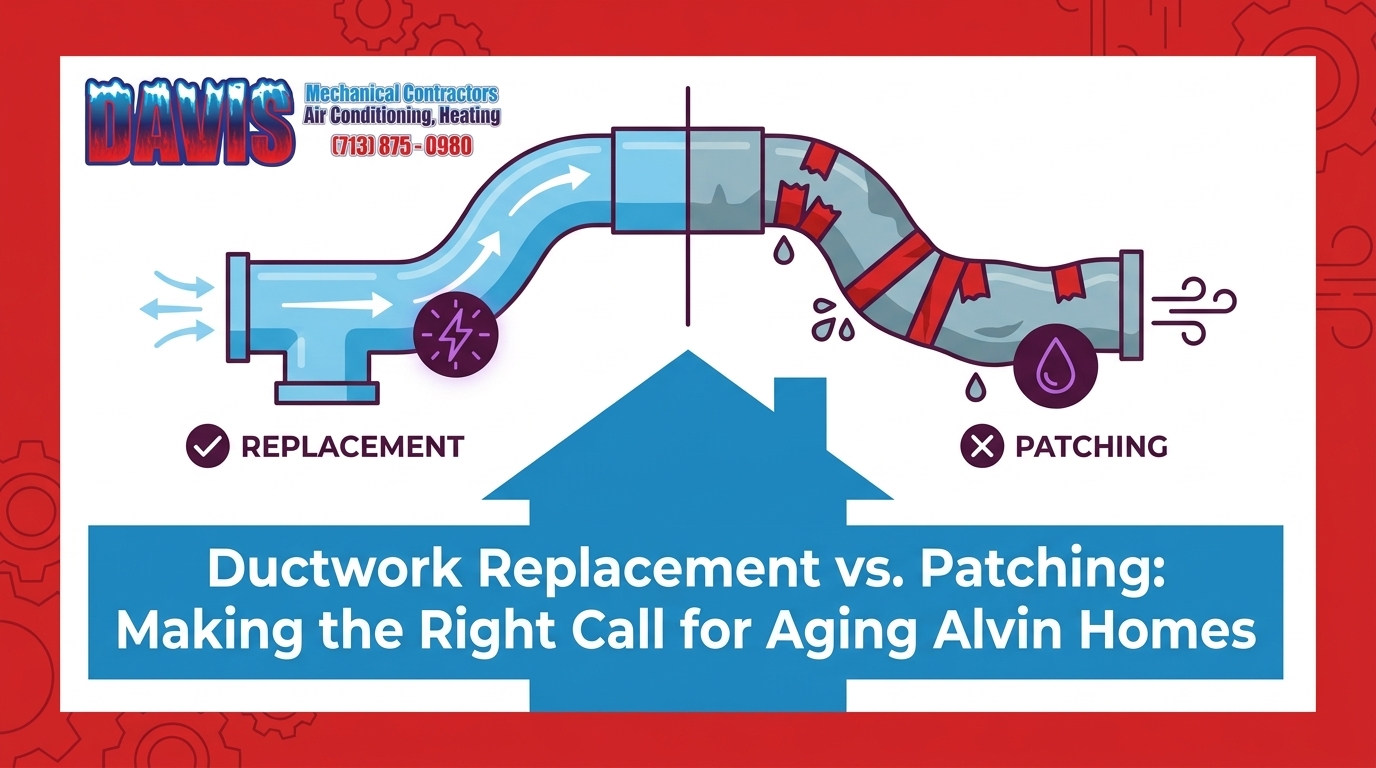
The Duct Tape Myth: Why Quick Fixes Fail Aging HVAC Systems
Duct tape is famously known as the universal repair tool, but there is one place it absolutely does not belong: on your actual HVAC ducts. Navigating ductwork replacement vs. patching: making the right call for aging Alvin homes requires much more than a quick, surface-level wrap of silver tape. Many homeowners operate under the misconception that any air loss can be solved by simply taping up a torn joint and moving on. The reality of HVAC science is far more complex, especially in older homes where the original materials have endured decades of extreme temperature swings.
A typical pattern we see is a homeowner dealing with uneven temperatures and high utility bills, only to discover severe, hidden duct leaks that previous technicians missed by only taping the visible connections. Surface-level inspections often fail to identify the true root of the problem. When a flexible duct begins to deteriorate from the inside out, applying tape to the exterior jacket is like putting a bandage on a broken bone. It might look like a repair, but the structural failure remains entirely unresolved.
The decision point for any homeowner is knowing the exact diagnostic threshold where taping and mastic patching is no longer sufficient. Relying on superficial patches for a failing duct network forces your blower motor to work harder, wastes conditioned air, and ultimately shortens the lifespan of your entire HVAC system. To truly restore your home’s airflow, you need a professional methodology that evaluates the core integrity of the materials, not just a quick visual sweep of the attic.
How Gulf Coast Humidity Accelerates Ductwork Degradation
Alvin’s subtropical climate dictates exactly how we approach HVAC repairs. The heavy Gulf Coast humidity does more than just make the outdoors feel oppressive; it actively destroys aging building materials. In our region, attic temperatures can easily exceed 130 degrees while remaining exceptionally humid well into September. When you have compromised, leaky return ducts, your system acts like a vacuum, pulling that dense, moisture-laden attic air directly into your home’s air supply.
This environmental reality accelerates the degradation of your ductwork. Flexible ducts consist of an inner liner, a layer of fiberglass insulation, and an outer vapor barrier. When the vapor barrier is compromised, the heavy humidity penetrates the fiberglass core. Wet fiberglass loses its insulating properties immediately. It becomes heavy, sags, and creates condensation points that further rot the surrounding materials. Simple tape patches fail prematurely in these conditions because the adhesive cannot bond to a damp, degrading outer jacket.
The 20 to 30 Percent Air Loss Reality
The impact of this degradation is staggering. According to Energy Star data, typical houses lose 20 to 30 percent of the air that moves through the duct system due to leaks, holes, and poorly connected joints. In a high-heat climate, losing nearly a third of your conditioned air into a boiling attic translates directly to massive energy waste.
The compounding effect:
- Increased workload: Your air conditioner has to run significantly longer to satisfy the thermostat, burning through electricity.
- Poor indoor air quality: As conditioned air escapes through supply leaks, unconditioned, dusty, and humid air is pulled in through return leaks.
- Material breakdown: The constant cycle of condensation and extreme heat causes the plastic components of older flex ducts to become brittle and shatter.
Our Professional Diagnostic Criteria for Duct Integrity
Guessing about the health of your attic network is a fast track to wasted money. That is why we rely on strict, professional diagnostic criteria for duct integrity to determine whether a system can be saved. Here is the step-by-step methodology we use to evaluate aging ductwork before recommending a patch or a full replacement.
- Static Pressure Testing: Before we even look at the physical ducts, we measure the static pressure of the entire system. This tells us how hard the blower motor is working to push and pull air. Unusually low static pressure often points to massive, hidden supply leaks, while high pressure can indicate collapsed inner liners restricting airflow.
- Core Material Inspection: We move beyond a quick visual check of the joints. We physically inspect the structural integrity of the outer vapor barrier and the inner fiberglass. If the fiberglass is dry, fluffy, and intact, the duct might be salvageable. If it is compressed, damp, or crumbling to dust upon contact, the material has failed.
- Airflow Measurement at the Register: By measuring the cubic feet per minute (CFM) of air arriving at each room’s register, we can isolate exactly which branch lines are suffering from severe air loss.
- Vapor Barrier Assessment: We check the outer plastic jacket for UV degradation and heat damage. If the jacket flakes away like dry leaves when touched, no sealant in the world will hold it together.
These baseline standards ensure that any repair we perform will actually hold up against the Gulf Coast climate, rather than failing a few weeks after we leave.

When Mastic and Metallic Tape Are the Right Call
Despite the limitations of standard duct tape, patching is still a highly effective and legitimate long-term solution—provided the ductwork meets the right criteria. The key difference lies in the materials used and the structural health of the duct being repaired. Professional duct sealing relies on UL-181 rated metallic foil tape and specialized mastic sealant, a thick, rubbery compound that hardens to form an airtight, permanent bond.
Candidates that qualify for professional patching:
- Isolated joint separations: If a flexible duct has simply slipped off a metal starting collar but the duct itself is in great shape, we can re-secure it with tension bands, metallic tape, and a heavy coat of mastic.
- Intact vapor barriers: The outer plastic jacket must be flexible, strong, and completely free of dry rot or heat damage.
- Healthy core insulation: The fiberglass inside the duct must be dry and fully expanded to provide the proper R-value.
- Hard pipe connections: Sheet metal plenums and rigid metal trunks are excellent candidates for mastic sealing, as the metal itself rarely degrades unless exposed to severe rust.
The application process: When we seal a healthy but leaky joint, we do not just slap tape over a gap. We mechanically fasten the connection, apply UL-181 tape to seal the seam, and then brush on a thick layer of mastic sealant over the entire joint. As the mastic cures, it expands and contracts with the ductwork, ensuring the seal remains airtight regardless of extreme attic temperature fluctuations. Patching is highly effective, but only when the underlying structural integrity of the duct is completely uncompromised.
The Breaking Point: When Total Duct Replacement is Mandatory
There is a definitive breaking point where attempting to patch an aging duct system becomes a waste of resources. When the core materials fail, full replacement becomes necessary for the safety, efficiency, and integrity of your HVAC system. We never recommend replacement as an upsell; we recommend it because patching a dying duct network will only lead to recurring breakdowns and skyrocketing energy bills.
The most severe risk of degraded ductwork is biological growth. When a vapor barrier fails and heavy Texas humidity saturates the fiberglass core, the dark, warm environment becomes a breeding ground for biological contaminants. Every time the blower motor kicks on, those spores are pushed directly into your living spaces. No amount of mastic can fix contaminated insulation.
| Duct Condition | Diagnostic Recommendation | Long-Term Outlook |
|---|---|---|
| Flaking, brittle outer jacket | Full Replacement | Material will continue to shatter; patches will detach. |
| Damp, compressed fiberglass | Full Replacement | Loss of R-value, severe risk of biological growth. |
| Collapsed inner wire liner | Full Replacement | Permanent airflow restriction causing motor burnout. |
| Clean core, separated collar | Mastic & Tape Patch | Permanent, airtight seal restores full efficiency. |
Furthermore, if we identify widespread, systemic air loss across the entire attic network rather than just one or two loose collars, patching is no longer viable. The labor required to chase down and seal hundreds of micro-tears in rotting material far outweighs the investment of installing a fresh, highly insulated, modern duct system that guarantees optimal airflow.
Finding the Hidden Leaks Other Technicians Miss
The HVAC industry has a bad habit of rushing. A common practice is for a technician to pop their head into an attic, quickly tape up the most obvious, visible leak they can reach, and move on to the next call. This approach leaves homeowners frustrated when their home is still warm and their energy bills remain high a month later. Our commitment is entirely focused on finding the root cause of airflow issues, leveraging thorough evaluations over quick fixes.
Recently, we responded to a call for an air conditioning system that was struggling to keep the house cool. The homeowner knew they needed AC repair and suspected some duct work was involved. During our evaluation, we uncovered severe, hidden leaks tucked far back in the attic that previous technicians had completely missed. The visible joints looked fine, but the hidden undersides of the branch lines were entirely blown out, dumping cold air straight into the insulation.
We fixed the AC and completed the necessary duct work cleanly and professionally. Completing complex ductwork without creating a mess in the home is a priority for us. Ripping out old, dusty ducts can be a dirty job, but a true professional ensures the workspace is left pristine. Proper ductwork resolution prevents the equipment from overworking, stopping recurring HVAC breakdowns before they happen.
Securing Your System’s Efficiency for the Fall Heating Transition
As we approach the early fall transition, evaluating your duct integrity becomes even more urgent. The shift from heavy summer cooling to fall heating exposes entirely different weaknesses in an aging duct system. Many homeowners do not realize that compromised ducts react differently when pushing heated air versus cooled air.
Heated air is less dense and naturally rises, which creates different pressure dynamics inside the ductwork. A joint that only leaked slightly under the pressure of cold air might suddenly separate completely when the furnace kicks on and pushes hot air through the network. This pressure imbalance can force heated air out into the cold attic, causing your furnace to run continuously while the house remains chilly.
Addressing duct integrity before the weather shifts entirely is the smartest move you can make for your home’s comfort. We always incorporate duct evaluations into broader seasonal preparations. If you are scheduling fall HVAC maintenance, having a technician verify the structural health of your attic network ensures that your system will transition smoothly from cooling to heating without a sudden spike in energy consumption.
Make the Right Call for Your Home’s Air Quality Today
Guessing about the health of your ductwork wastes energy, degrades your indoor air quality, and puts unnecessary strain on your HVAC equipment. Whether your system needs a few targeted mastic repairs or a comprehensive upgrade, the only way to know for sure is through a clear, professional evaluation.
Getting definitive answers gives you confidence in your HVAC investment. If your aging home is struggling to maintain consistent temperatures, do not wait for the system to fail entirely. Schedule a comprehensive duct inspection today to secure your system’s efficiency before the fall transition is fully underway.
Frequently Asked Questions
How do you know if your ducts need to be replaced?
You will typically notice uneven room temperatures, excessive dust buildup, and steadily rising energy bills. A professional evaluation will confirm replacement is necessary if the outer jacket is brittle, the inner fiberglass is damp or compressed, or the inner wire liner has collapsed. Once the core materials degrade, repairs are no longer effective.
Can you just patch leaky ductwork?
Yes, but only if the core materials are still structurally sound. If the vapor barrier is intact and the insulation is dry, we can use professional-grade mastic sealant and UL-181 metallic tape to permanently seal isolated joint separations. Standard hardware store duct tape should never be used for these repairs.
Is it worth replacing ductwork in an old house?
Absolutely. In older homes, original ductwork is often undersized, poorly insulated, and heavily degraded from decades of extreme attic temperatures. Replacing it with modern, highly insulated ducts dramatically reduces energy waste, improves indoor air quality, and extends the life of your heating and cooling equipment.
How long does flex duct last in a hot Texas attic?
Flexible ductwork typically lasts between 15 to 20 years in a demanding climate. The extreme heat and high humidity of a Gulf Coast attic accelerate the breakdown of the plastic vapor barriers and adhesives. Once the duct passes the 15-year mark, it becomes highly susceptible to air leaks and material failure.
Why do duct leaks cause higher humidity indoors?
When your duct system has leaks on the return side, it acts like a vacuum, pulling unconditioned air from the attic or crawlspace directly into your HVAC system. In our climate, that attic air is loaded with heavy moisture. The system then distributes that humid air throughout your living spaces, making the home feel sticky and uncomfortable.